What this form asks
27 questions over 7 pages, 15 of them required. Some questions appear only after an answer that needs them.
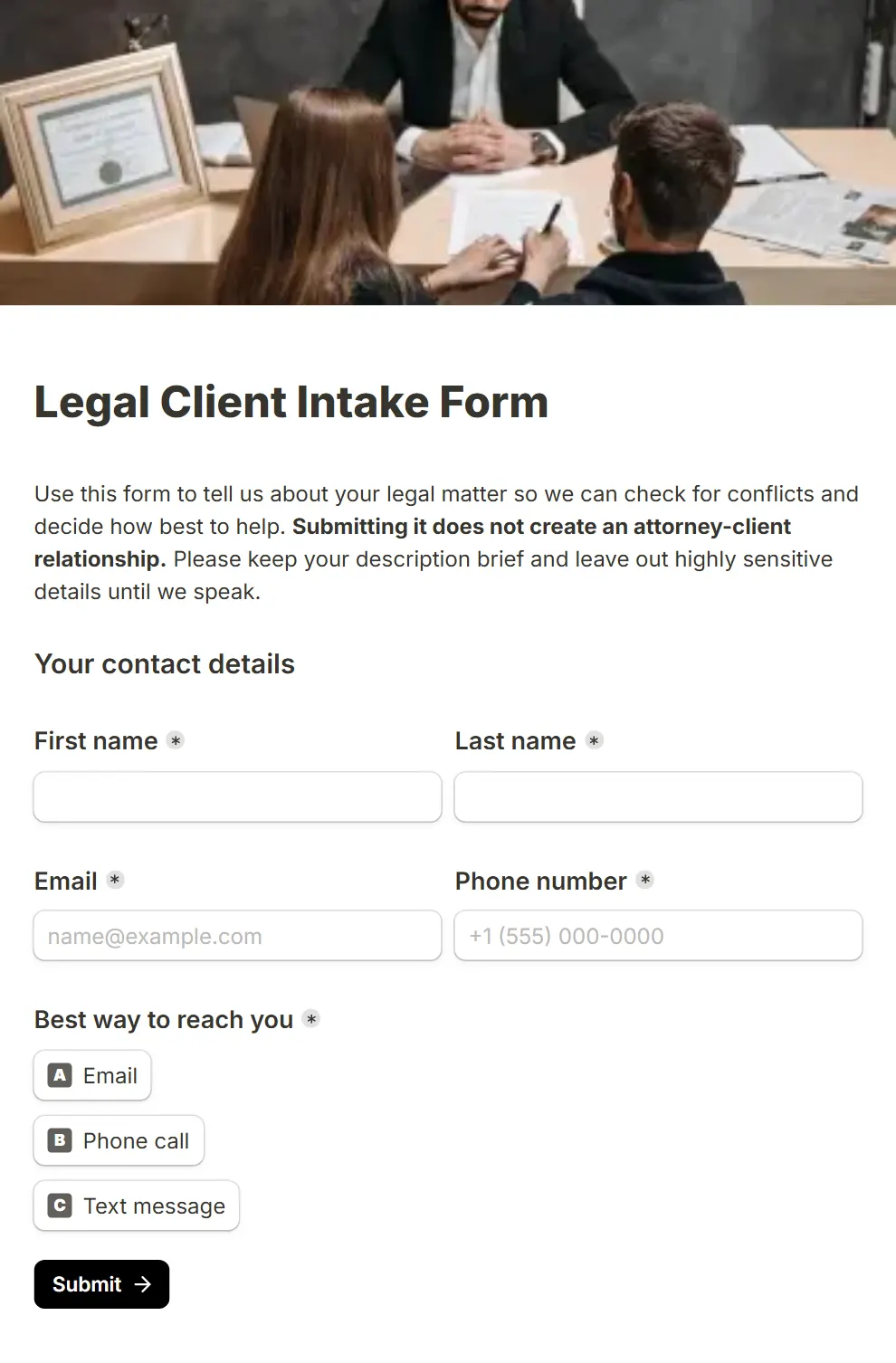
- First nameShort answer · required
- Last nameShort answer · required
- EmailEmail · required
- Phone numberPhone number · required
- Best way to reach youSingle choice · required
- May we leave a detailed voicemail?Single choice
- Type of matterDropdown · required
- Briefly describe what happenedLong answer · required
- What outcome are you looking for?Long answer
- City and state or region where this happenedShort answer · required
- Names of the opposing partiesLong answer · required
- Other people or companies connected to the matterLong answer
- Is the other side represented by a lawyer?Single choice · required
- Name of their lawyer or firmShort answer
- Date of the main eventDate
- Has a court case already been filed?Single choice · required
- Court and case numberShort answer
- Is there an upcoming court date or deadline?Single choice · required
- Date of the court date or deadlineDate
- What is the deadline for?Short answer
- Have you consulted another lawyer about this matter?Single choice · required
- Name of the lawyer or firm you consultedShort answer
- How were you referred to us?Dropdown
- Name of the person who referred youShort answer
- Documents related to the matterFile upload
- No attorney-client relationshipMultiple choice · required
- Accuracy of informationMultiple choice · required
This legal client intake form collects what a law firm needs before a consultation: the prospective client's contact details, the type of matter and what happened, the other parties so the firm can run a conflict check, any court case or deadline, and whether another lawyer has been consulted. It runs over six pages and closes with two acknowledgements, including that submitting the form does not create an attorney-client relationship.
What the form covers
The client gives their name, email, phone, the best way to reach them and whether a detailed voicemail is acceptable. The matter pages ask for the type of matter, a brief description of what happened, the outcome they want, and where it happened. For the conflict check, they name the opposing parties and anyone else connected to the matter, and say whether the other side has a lawyer. The dates page asks for the main event's date, whether a case has been filed (with the court and case number), and any upcoming court date or deadline. The last pages ask about prior counsel and referrals, take related documents, and record the two acknowledgements.
Who uses a legal intake form
- Law firms and solo practitioners screening new enquiries before a consultation.
- Legal aid organisations triaging requests for help.
- Firms in family, employment, personal injury or immigration law, who adapt the matter types to their practice.
How to use this template
- Use the template. Click "Use this template" to copy the form into your workspace.
- Fit it to your practice. Change the matter types and the acknowledgement wording to your firm's own.
- Share it. Embed the form on your contact page, or send the link before a consultation.
Frequently asked questions
Why does the form ask for the opposing parties?
So the firm can check for a conflict of interest before it discusses the matter.
Who can see the client's documents?
Only members of your workspace. Uploaded files are stored privately and opened from the Submissions tab.
Should I review the acknowledgement wording?
Yes. The template's wording is a starting point; a firm sets its own disclaimer and intake terms.